
How should we define an explosive play?
Expanding on some recent research about explosive play thresholds in the NFL


Kind of, at least for now. As I’m sure you’ve noticed, I haven’t done any written content (or really content of any kind) for the past couple of months. In that time, I’ve paused all paid subscriptions and that’ll continue at least through July because I can’t guarantee how much more I’ll do until we get closer to actual football.
Since the NFL draft, the reason I’ve taken some time off from content is twofold. One, the weather is getting much better so I have more reason to get outside and off my computer. When I have done non-work stuff on my computer lately, it’s been for more personal work like some F1 research (we’ll see if I get around to sharing that), WNBA modeling, and more.
The second reason is that I really just haven’t found anything football related that has inspired me. Fortunately, I’m not a big media corporation so I’m not bound to writing the same offseason articles that everyone else makes (ranking quarterbacks, OTA winners, etc.). I also told myself when I started this Substack that I’d only write what I want to write about and hopefully the people following me would latch on to those things as well. So why am I writing today? Well, something that I read the other week piqued my interest.
What got my attention was an article from Jeff Berckes in which he tried to find the optimal yardage thresholds for explosive plays. In the past I’ve used 15 yards as my threshold but haven’t had a particularly good reason for that benchmark. I’ve also kept the threshold equal for both rushing and passing because the yards count the same regardless of how they are earned and it further demonstrates which method is more efficient overall.
While Jeff’s article approached the question in a novel and interesting way, I found myself wanting to put my own spin on it and add rigor to the threshold that I choose. This isn’t intended to be a “gotcha” article, but instead to be more about challenging good ideas, expanding on the research, and providing my own insights on it.
Extending the methodology
In his article, Jeff calculated the winning percentage for teams that won the explosive play differential at several combinations of yardages. But, he only used some of the predefined yardages that other sources had listed for their explosive play thresholds. I took it one step further and measured the same thing for every yardage from 10 to 25 yards:
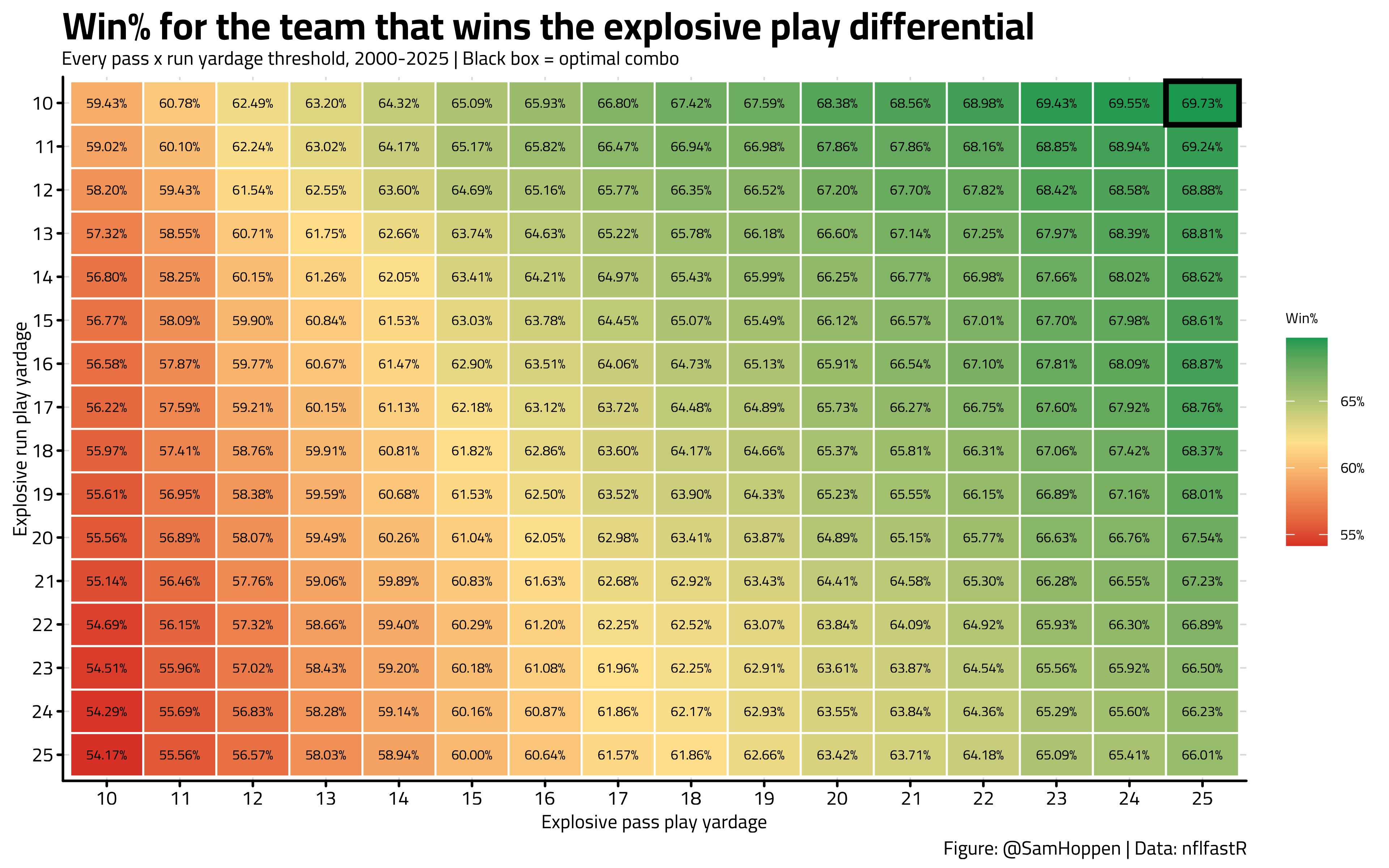
In this case, we see that a 25-yard pass and a 10-yard run give us the best results. What I think this plot really tells us is that having success passing the ball is more important than having success running the ball, but we already knew that was the case. If you can’t generate chunk yardage passing the ball, you’re just not going to win in today’s NFL.
I’m not sure that this helps us find the right threshold for explosive plays though because we know that more yards is better. The other challenge with explosive plays is that they’re descriptive and not predictive. Sure, having more explosive plays in a game will lead to more wins, but gaining more yards (how you get explosives) will do just the same. For that reason, I’m not sure that looking at win rates based on what essentially amounts to a difference in yardage gets us the answer that we want. So, where do we go from here? Well, I have a few ideas.
What about using EPA?
One common suggestion I’ve seen regarding explosive plays is to use EPA thresholds. For example, what if we define any play with an EPA greater than 1.0 as an explosive play? If we look at the distribution of EPA since 2015, we see that 1.0 EPA on a play level lands at about the 80th percentile.
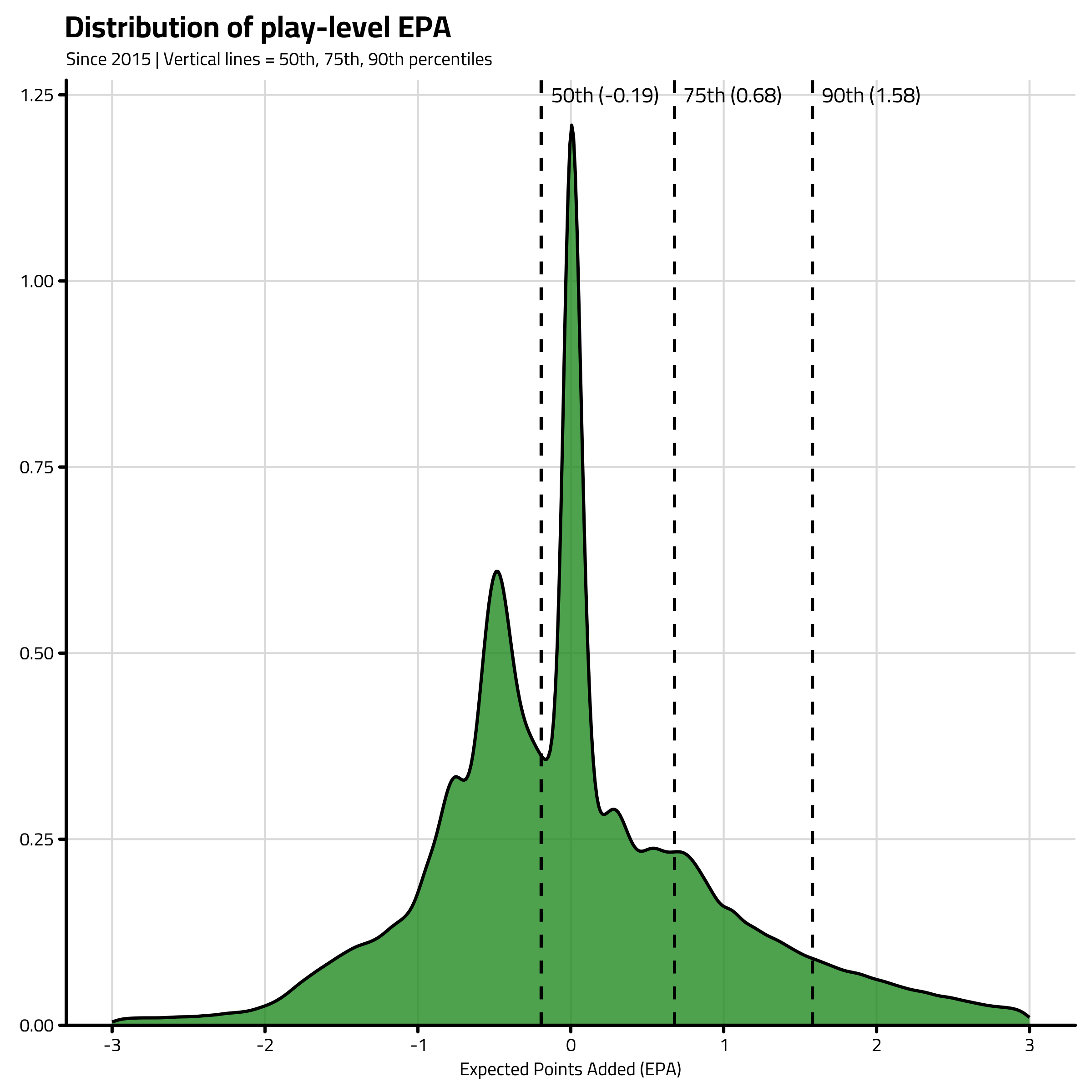
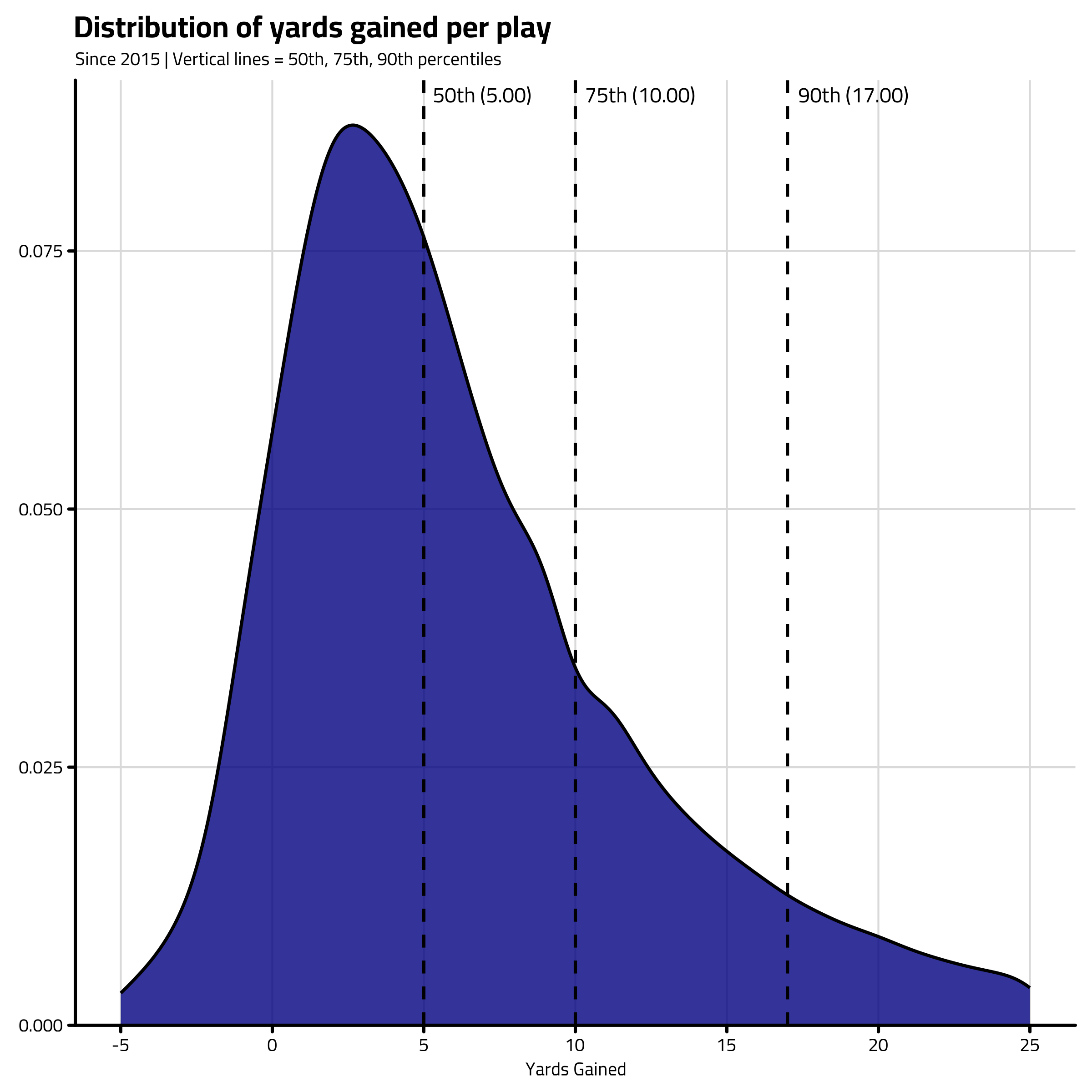
If we compare that to the distribution of yards gained we see that the 80th percentile lands just over 10 yards, which is about where some of the lower boundaries of explosive play thresholds start:
In theory, I think an EPA-based explosiveness stat could be useful, but there are two issues with it as a replacement for a simple yardage threshold. First is the interpretability. EPA continues to gain traction as a more widely used stat across football analysis, but it’s still not common parlance across the entire football cognoscenti. While I think “we added one point to our expected total points” is easier to understand, there are still so many different types of plays that could yield an EPA of 1.0.
Two, a 1.0-EPA gain and a 15-yard play measure slightly different things. The difference is that EPA simply adds context to a 15-yard gain and determines its importance based on the situation. Below is a chart, split by down, that shows average EPA based on the yards gained and field position:
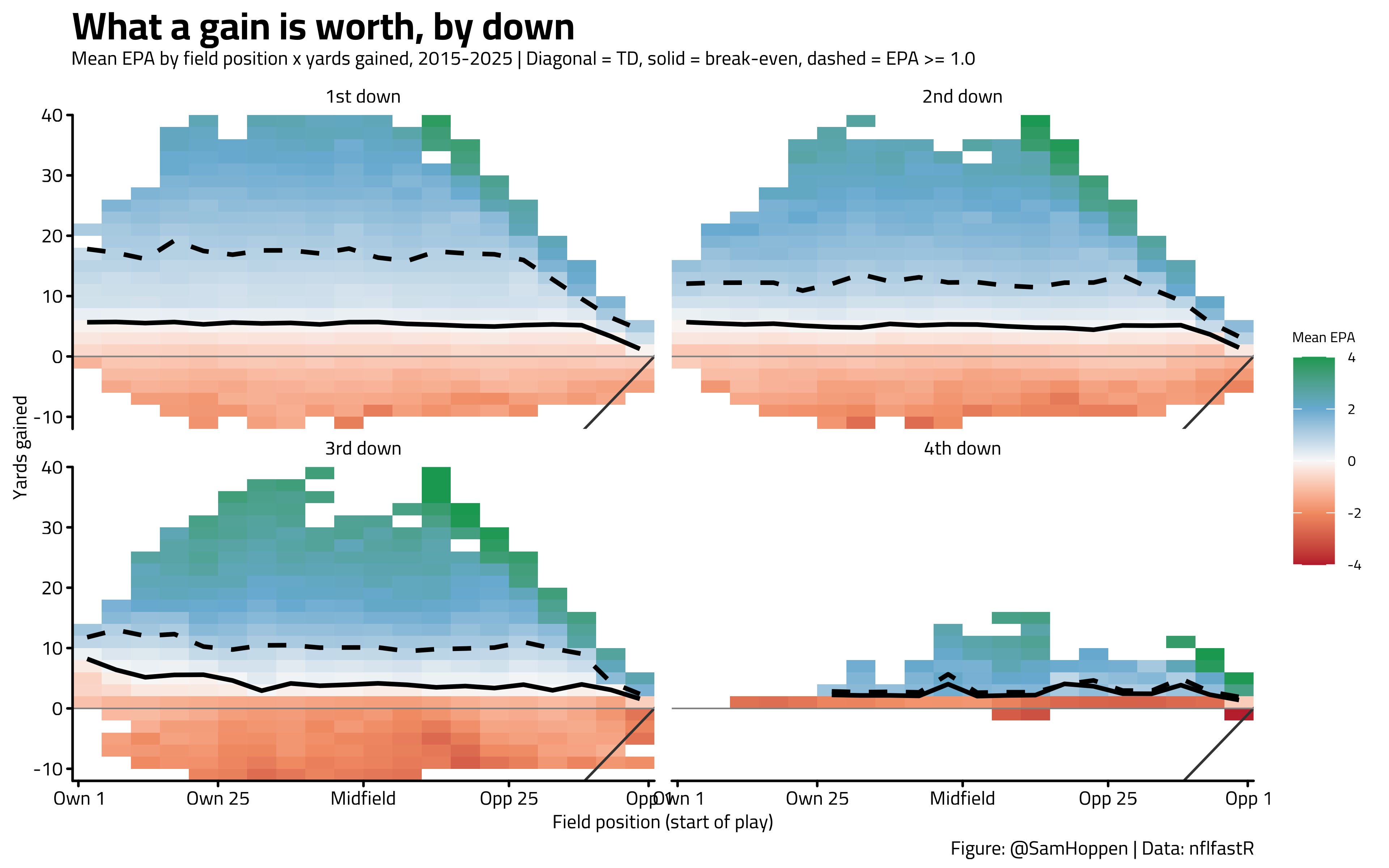
This shows us that the threshold for an average EPA of 1.0 hovers anywhere from 10 to 20 yards gained outside the red zone. Where it could be helpful is within the red zone where teams only have a limited number of yards to gain and defenses tighten up in that part of the field as well, so moving the ball becomes all the more critical and impressive.
That said, what we’re trying to measure with explosive plays is an offense’s ability to gain chunk yardage. Obviously, the two are highly correlated and there’s a bit of a flaw in wanting to measure something yards-based when we do have EPA available. Still, I came here to find an answer to the explosive-yardage threshold.
Where is the breakpoint?
I’m not breaking any news when I say that the goal of each drive is to score points. With that in mind, I had the idea to try to find the breakpoint at which the relationship between yards gained and scoring probability on a drive dramatically changes. In other words, I wanted to identify the point at which a gain becomes explosive enough to meaningfully shift a drive’s scoring odds.
Fortunately, nflfastR already has scoring probabilities (field goal probability and touchdown probability) for the start of each play, which we can use to calculate each play’s scoring probability added (SPA). From there, I fit a segmented (piecewise-linear) regression on yards gained with SPA as my target. Instead of assuming one straight-line relationship across all yardages, this method searched for the yardage value where the slope itself shifts, returning both an estimated breakpoint and a confidence interval around it. Below is the result:
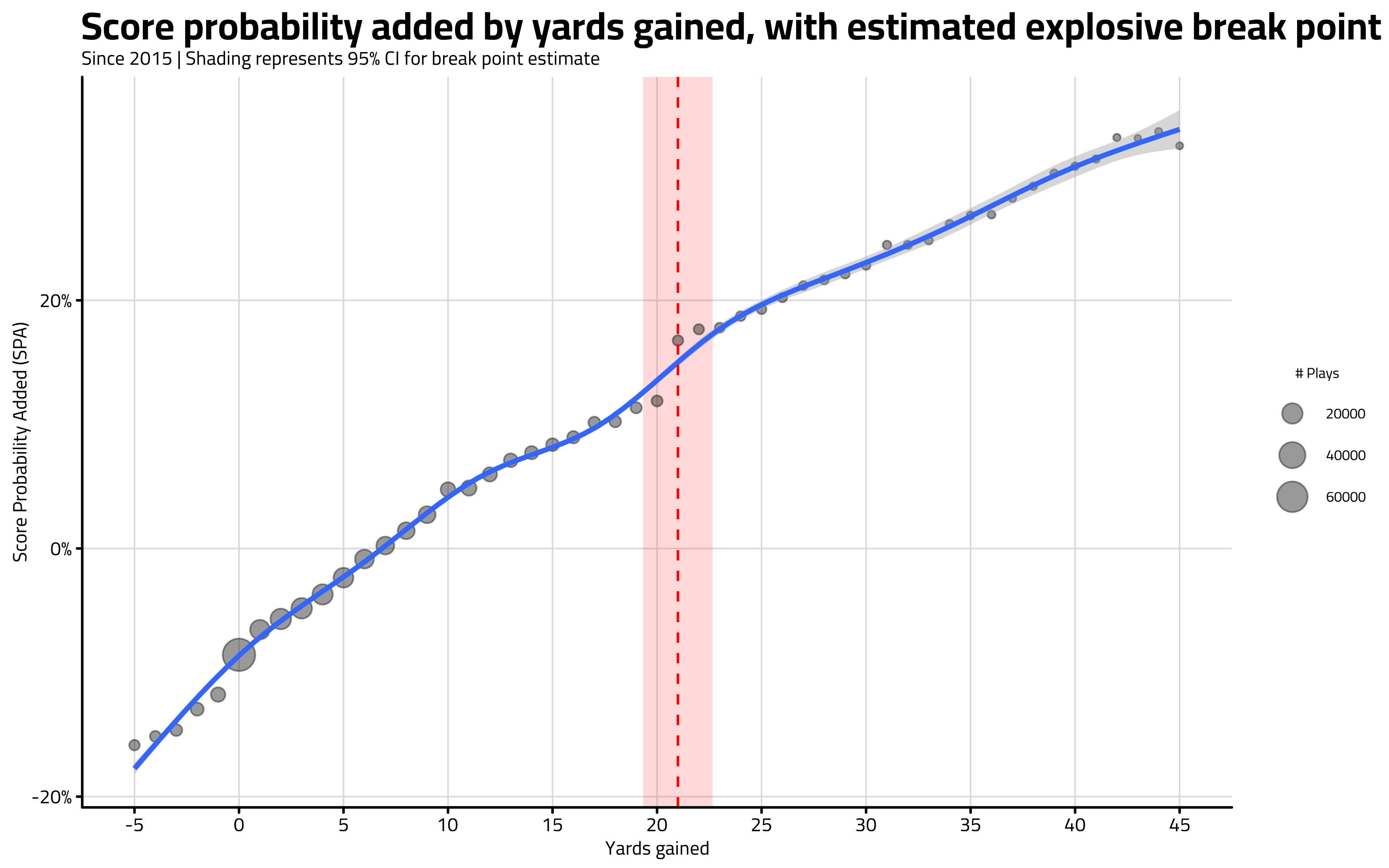
This gives us an explosive play threshold of about 21 yards across all play types. What this means is that at 21 yards we find that the relationship between yards gained and SPA isn’t a single straight line. Put another way, after 21 yards gained is where additional yardage adds scoring probability at a slower rate than the previous values. Overall, this is where a gain stops behaving like a normal play and starts acting differently in terms of its impact on scoring.
Should the threshold be different?
As I mentioned, I’ve historically been in favor of keeping the yardage threshold the same across run and pass plays. One of the better arguments against that came from Sebastian, who proposed that an explosive play should be one in which a high number of yards were gained relative to the usual distribution. Below is the same yardage distribution view, split by passing and running plays:
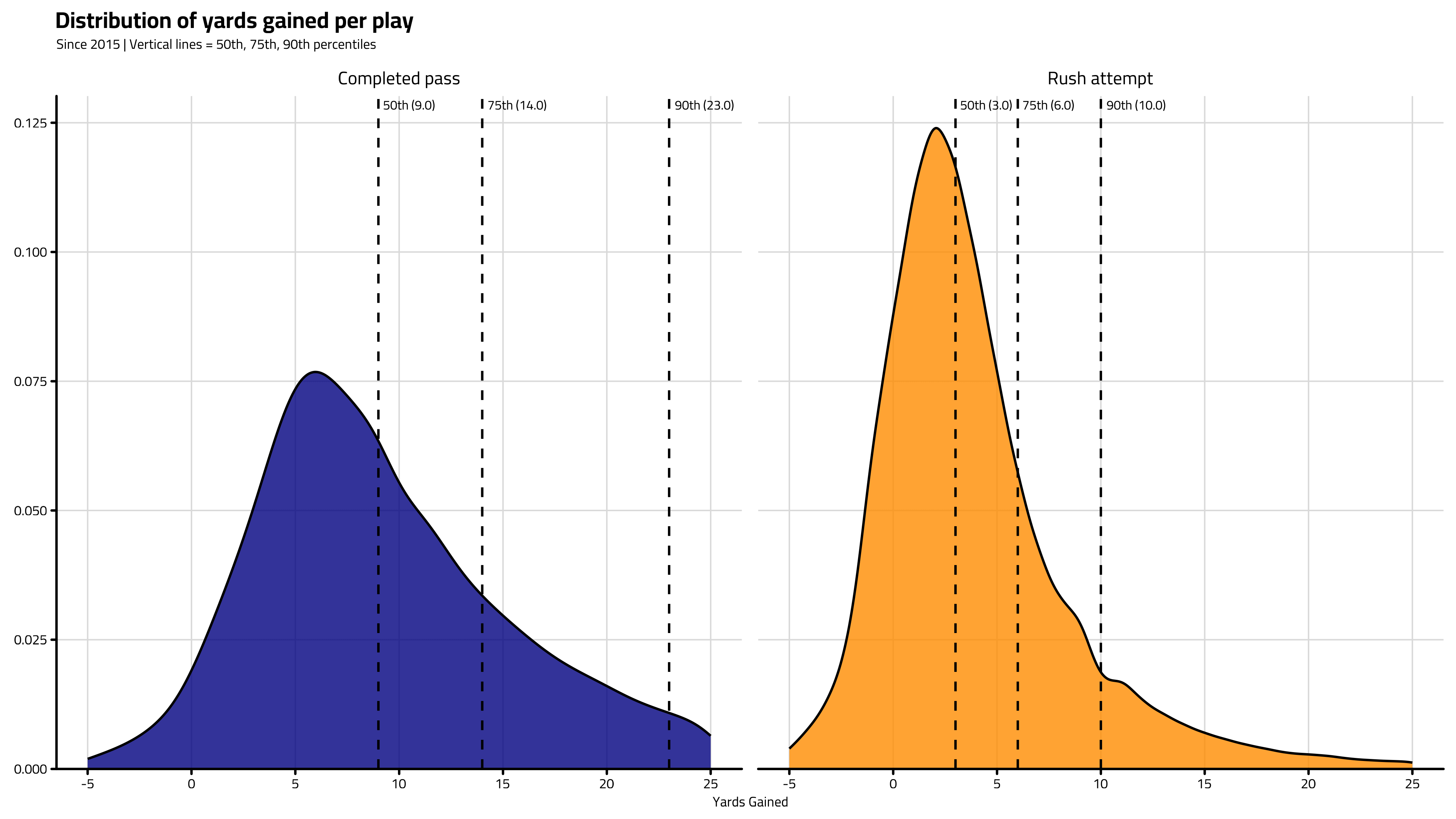
If you want an easier way to compare the two, here’s a look at the cumulative distribution of yards gained split by play type:
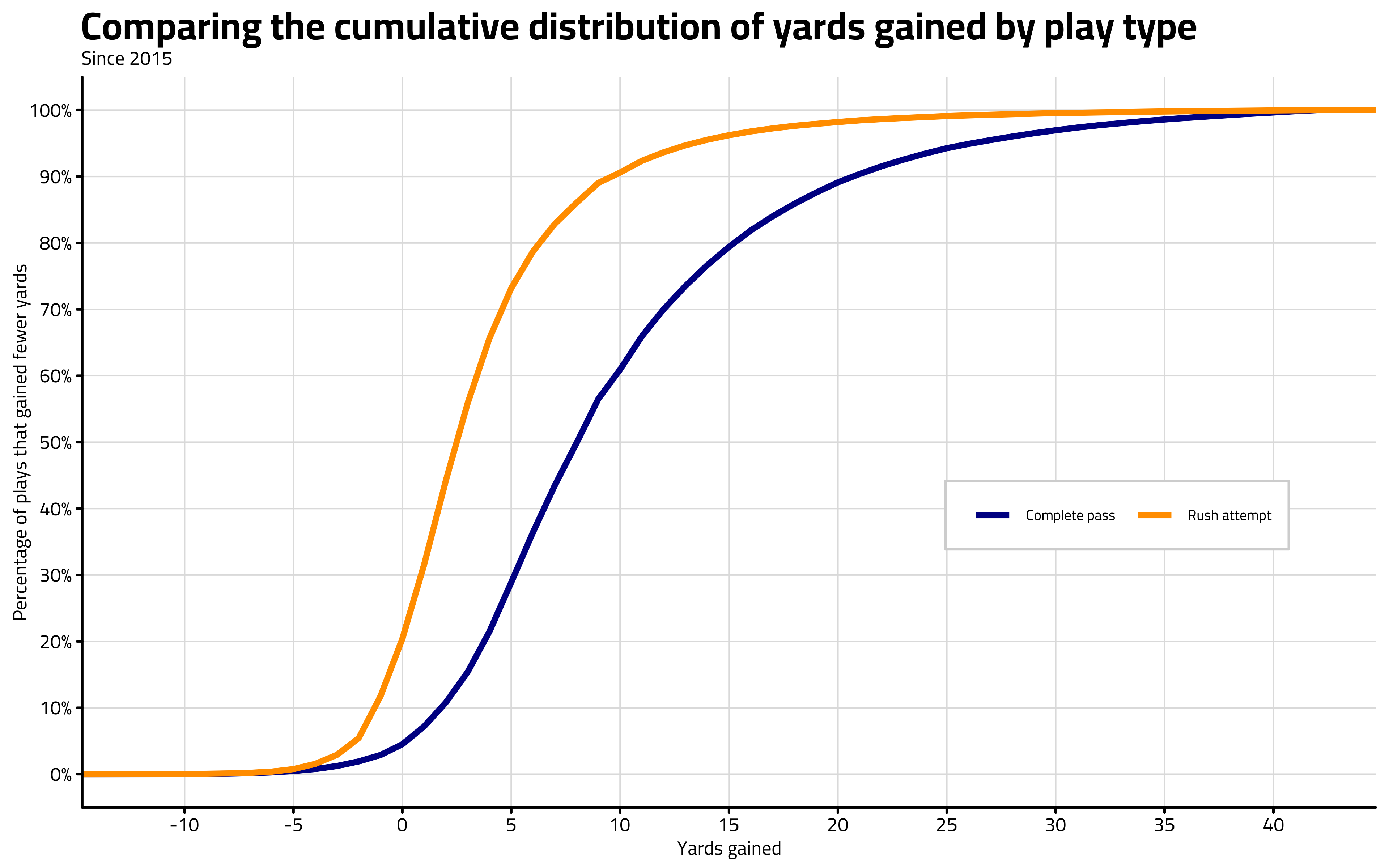
A rush of at least 10 yards falls roughly in the 90th percentile while that bar only clears 60% of completed passes. If we were to use the 90th percentile for both, that would leave us with 10 yards for rushing plays and 20 yards for passing plays. Further reasoning for wanting different thresholds could be that rushing yards per play are lower than those of their passing equivalents, so reaching that 10-yard threshold on runs is a stronger signal of team strength than a team reaching 10 yards on a passing play would give us.
Let’s revisit the methodology that I used in the previous section for a second. If we split the predictions between runs and passes, we get some slightly different results:
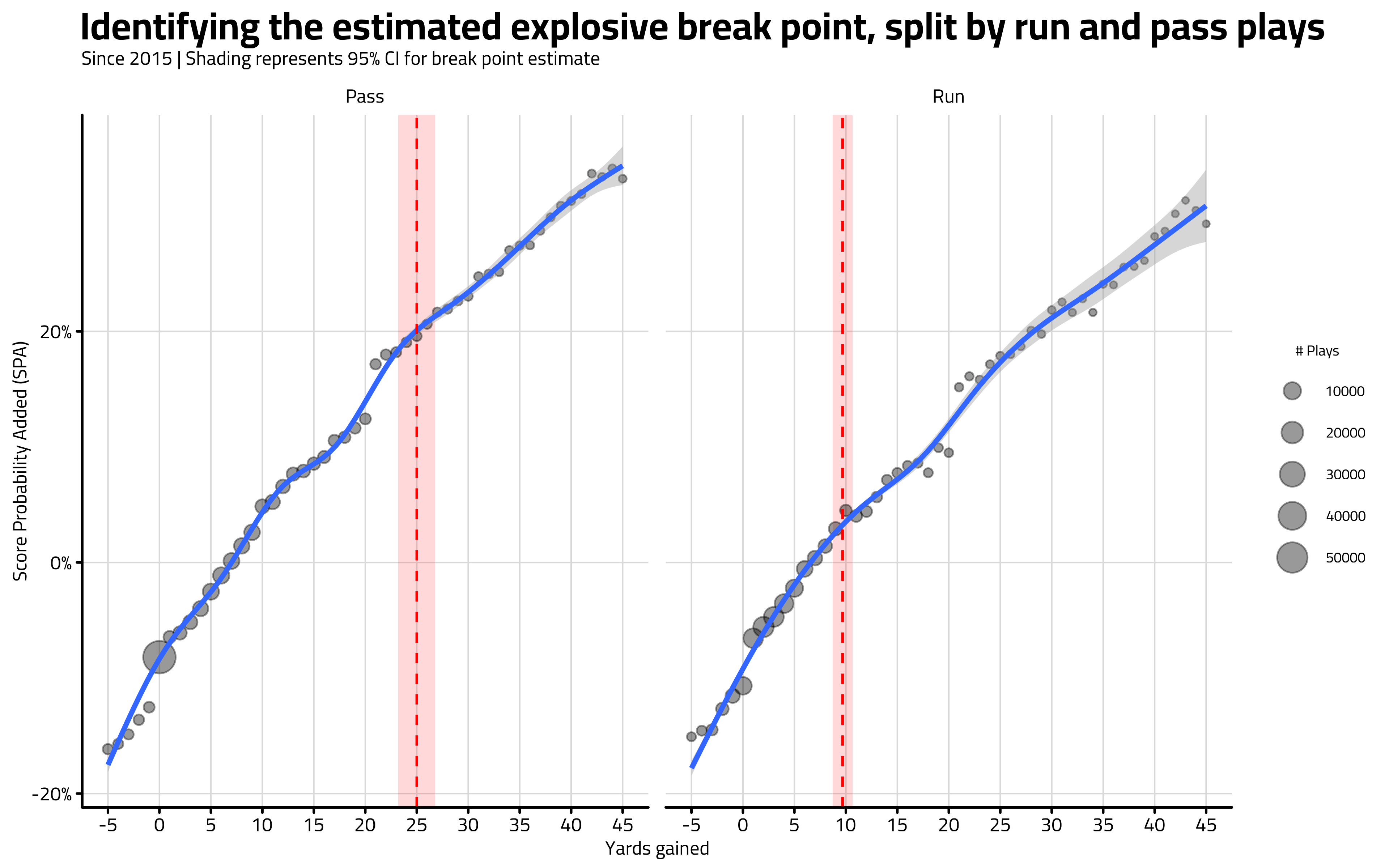
For a pass play, our breakpoint is at 25 yards while the breakpoint for run plays is right around 10 yards! It makes sense that the all-plays breakpoint is skewed a bit more towards that of the passing breakpoint given passing plays happen at a higher rate overall. Oddly enough, you’ll remember that this 25-yard and 10-yard split for passes and runs, respectively, is the same one that Jeff’s methodology would have had us use.
Ultimately, I’m not going to fault anyone for using different levels of thresholds for explosive plays (so long as you label them appropriately). I also don’t think that this is necessarily going to solve different sources having different thresholds, but hopefully it has given you all some food for thought. All that being said, I do plan to change my thresholds this upcoming season to reflect the 25-yard and 10-yard values that my methodology found.
I’m looking forward to getting back to doing some more writing over the coming months as we ramp up towards the season. Until next time, hope you enjoyed this!