
Creating a position-adjusted big board
Using the consensus big board for NFL prospects while adjusting for position

Last week on the Wharton Moneyball podcast, Brandt Tillis, the Panthers’ executive vice president, joined the show. In that episode, he was asked if he thinks the analytics community takes positional value (in the draft) too far as some suggest the only positions you should take in the first round are quarterback, edge, wide receiver, and left tackle. As a response, Tillis said, “You just need to get impact players… If you could draft a Hall of Fame center at whatever pick you’re at, would you rather do that or draft another guy that’s a starting edge for eight years but never stands out.”
Obviously, you’d prefer to draft a Jason Kelce than, say, a Bradley Chubb. But the ceiling of the impact those two players can have is wildly different. An edge can turn into a Myles Garrett or JJ Watt the same way a center can turn into Jason Kelce, so which of those would you prefer? It’s why teams should absolutely be taking position into consideration when drafting.
Over the years, consensus prospect big boards have done a great job of identifying the rank order of which players project best to the next level of football. However, one key piece in that has been missing is the positional value of those players. Now, people who create these boards may take position into consideration, but based on some of the players I’ve seen at the top of this year’s boards I’m assuming that the majority of analysts are not. With that, I’ve come up with a mathematical way to do that position adjustment for us, giving us a position-adjusted big board.
Note: you can find my methodology for this at the end of the post if you’re interested in it.
Position-adjusted Big Board
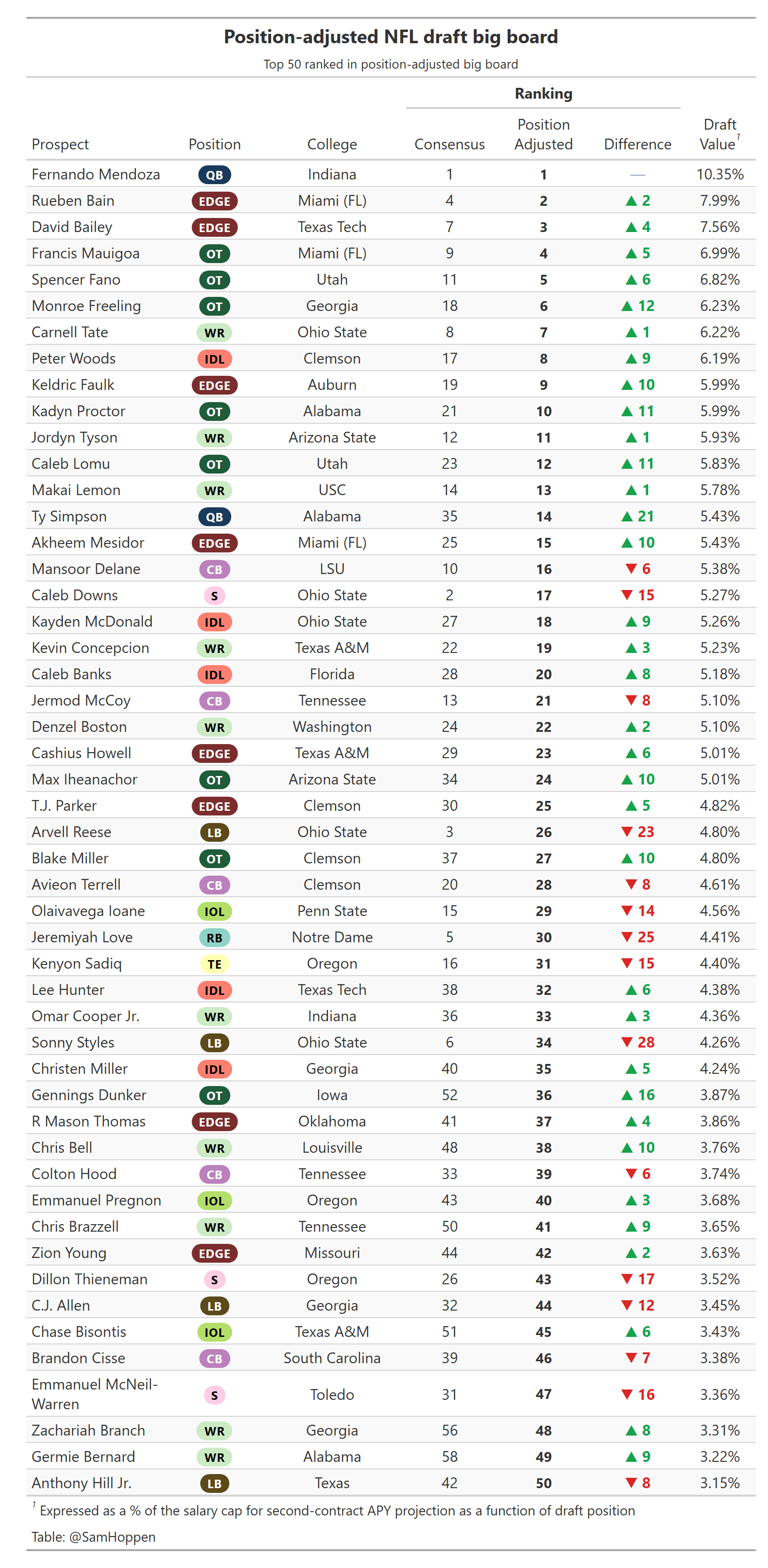
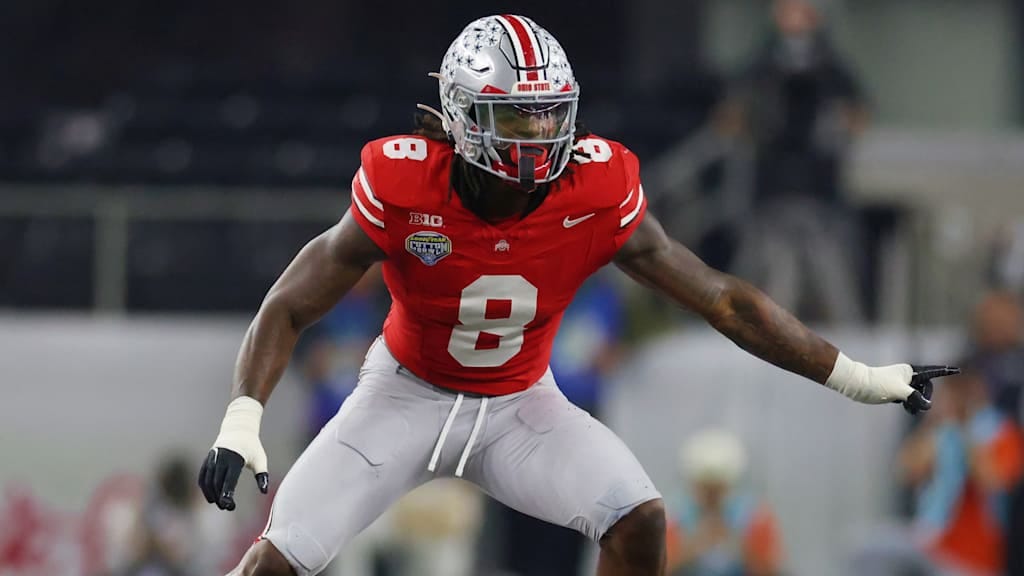
One thing you’ll notice immediately is the edge defenders and tackles moving up. These rankings are largely driven by the other prospects that are ranked in the top 50. In a draft class that is dominated by edge rushers and tackles, every other position is going to be dragged down. As a result, Arvell Reese, who is currently the most-mocked player to the Jets at 2nd overall according to Grinding the Mocks, falls all the way down to 26th. That said, the position designation for Reese (and other players) is critical. Should Reese play more of a hybrid OLB/EDGE role in the NFL, that obviously changes the outlook on the positional value he can provide. Based on what I’ve read it seems like he’ll play more of the off-ball linebacker role, though, so this may be a case where it is in fact accurate.
I mention this in the methodology below, but quarterbacks have a bit of an arbitrary value in the position-adjusted board. Fernando Mendoza remained at the top as he was already the consensus top player, but with the value that I chose for quarterbacks, you can see that Ty Simpson has also risen quite a bit. Some analysts have also linked Simpson to the Jets at 16th overall and this may suggest it’s not as much of a reach as some have said.
The Jeremiyah Love Conversation
It’s time that we have a conversation. I hate to be the one to keep belaboring the point, but it’s still pretty crazy to me that there are people suggesting that drafting Jeremiyah Love in the top 10, let alone top 5, is a +EV draft move. This exercise should further illustrate the relative value of running backs compared to others, even if they’re considered one of the best prospects in the class. It also complements this chart that I posted the other day:


Obviously, the relative bar for how good Love would need to be to pay off his draft cost starts to drop significantly after you get past the 5th pick. Even so, it’s pretty clear how different the value can be between a running back and wide receiver at that point in the draft.
The other issue with drafting a running back so highly is that the teams at the top of the draft are all the worst teams, so the impact that a running back can truly have in that instance is lessened to some extent. When the Eagles signed Saquon Barkley and they went on to win a Super Bowl, they already had a fantastic roster with an incredible offensive line. The teams being mocked to draft him, mainly the Titans and the Giants, are far from the level of roster that Philly had where adding an elite running back to the team is going to unlock the ceiling in the offense.
